
Government Policy
Nepal Reopens Foreign Employment Approvals for All 12 Gulf and West Asia Destinations
7 July 2026
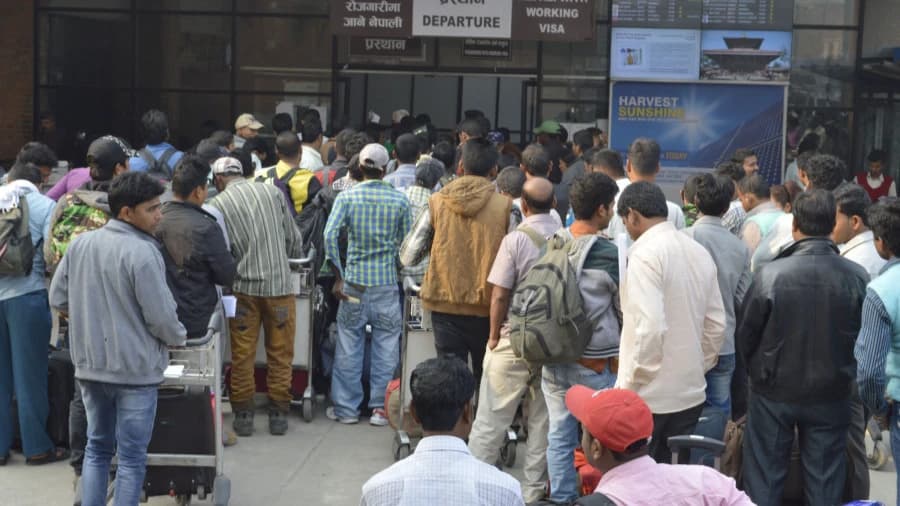
Nepal has resumed issuing foreign employment approvals for all twelve Gulf and West Asian destinations, ending a suspension that had stalled the departures of tens of thousands of workers for roughly six weeks.
The Department of Foreign Employment (DoFE) reopened both institutional and individual labour approvals for Saudi Arabia, the United Arab Emirates, Qatar, Kuwait, Bahrain, Oman, Iraq, Yemen, Jordan, Lebanon, Turkey and Israel. The decision followed a recommendation from the Emergency Response Team, a high-level mechanism under the Ministry of Foreign Affairs that coordinates the safety of Nepali nationals abroad.
Approvals had been halted on 1 March, a day after the outbreak of the confrontation involving the United States, Israel and Iran. Citing the safety of its citizens, the government initially froze new and existing permits across the region, and the Department of Immigration barred workers without valid labour permits from boarding flights. At the height of the disruption, industry representatives estimated that more than two thousand workers a day were being turned away, while thousands who already held visas — including large numbers bound for the UAE, Saudi Arabia and Qatar — waited in limbo for clearance to travel.
The reopening came in stages. Authorities first allowed returning workers who were home on leave to travel back to seven comparatively stable countries, before extending approvals to the full list once the Emergency Response Team assessed that conditions had sufficiently stabilised.
Behind the reversal lies Nepal's deep economic reliance on overseas work. Roughly three in four Nepali migrant workers are employed in the Middle East, and remittances account for more than a quarter of the country's economic output. With domestic unemployment estimated above 20 percent and hundreds of young people leaving the country every day, officials faced mounting pressure from job seekers and recruiters to restart the process.
For workers and licensed agencies, the resumption restores a critical pipeline — but the operating environment remains sensitive. Air services across parts of the Gulf were irregular during the crisis, and risks tied to the Strait of Hormuz and the Red Sea have not fully eased. Recruiters are advising candidates to keep documentation current, complete mandatory pre-departure orientation, and ensure that foreign employment insurance and Social Security Fund contributions are in place before travel.
Rights organisations that monitored the suspension have urged destination governments and employers to strengthen early-warning systems, guarantee access to safe shelter, and refrain from withholding workers' documents or wages during emergencies — safeguards that agencies committed to ethical recruitment are expected to reinforce.
The episode is a reminder that foreign employment from Nepal is governed as a matter of state policy, not private commerce, and that approvals can be paused or resumed rapidly in response to geopolitical events. For employers sourcing Nepali personnel, working through licensed agencies with verified demand documents and robust duty-of-care processes remains the surest way to keep deployments compliant and workers protected.
More on hiring from Nepal
- AI Helps Nepal Preserve Indigenous Languages in the Digital Age. — Digital news
- Nepal Government Directs State Agencies to Prioritize Domestic Products. — Business news
- Nepal's Manpower Agencies Halt Labour Approvals — What Employers Hiring Gorkha Manpower Need to Know — Government Policy
- All news and regulatory updates — Labour approvals, policy change and what it means for employers
- Manpower recruitment from Nepal — Sourcing, vetting, documentation and deployment, end to end
- Candidate support — What deployment involves for the people we place